Baseline IoU 0.000
Loading…
* Project Leader † Corresponding Author
A short introduction to CoordRefer.
The video includes an AAC stereo audio track. Click play and check the speaker icon if your browser starts with volume disabled.
Drag, zoom, or pan any view—the other two cameras stay synchronized.
“A round trash can is located under the counter top.”
Drag to rotate · Scroll to zoom · Right-drag to pan
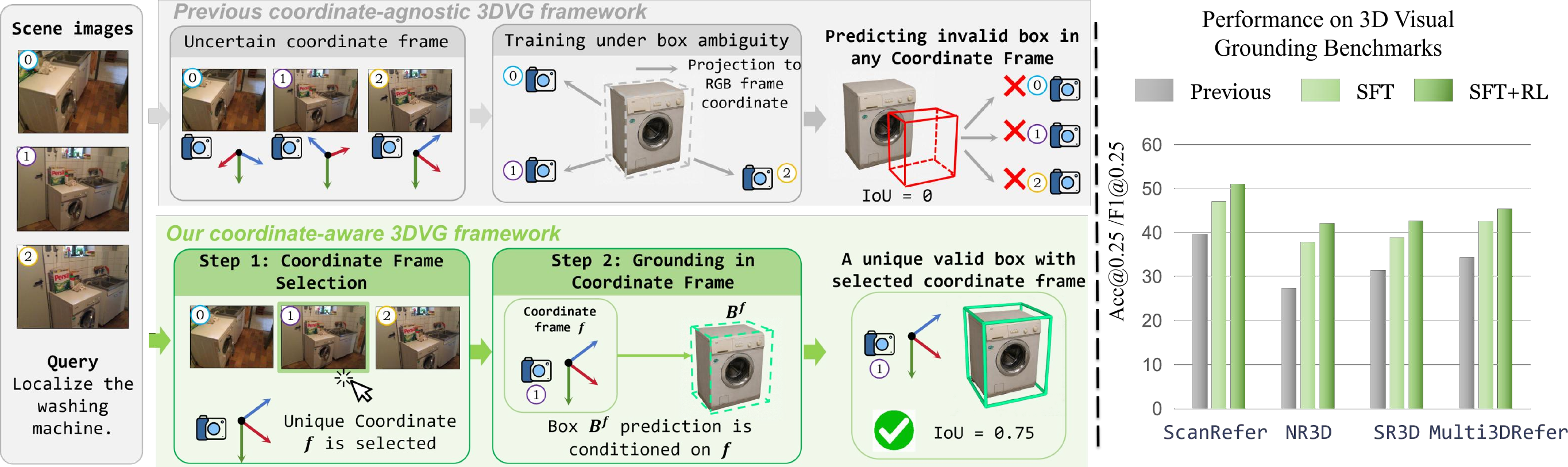
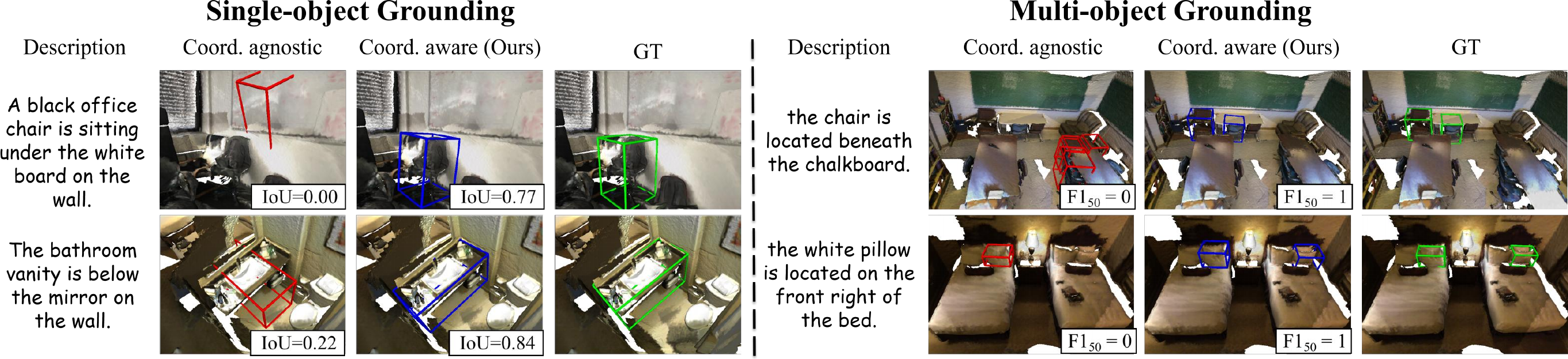
CoordRefer selects a coordinate frame before predicting its coordinate-conditioned 3D box.
Joint frame-and-box prediction creates multiple equivalent targets across coordinate systems.
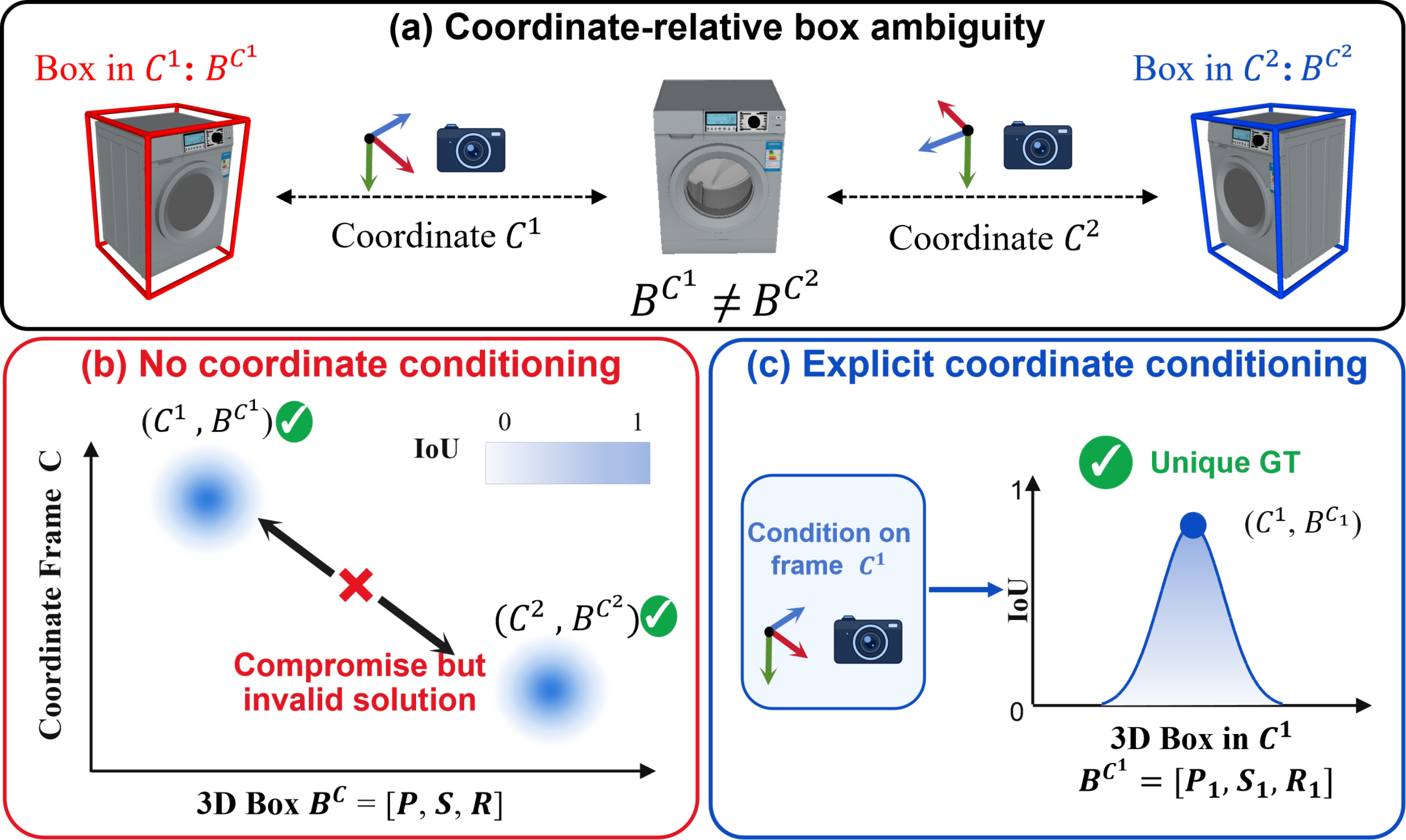
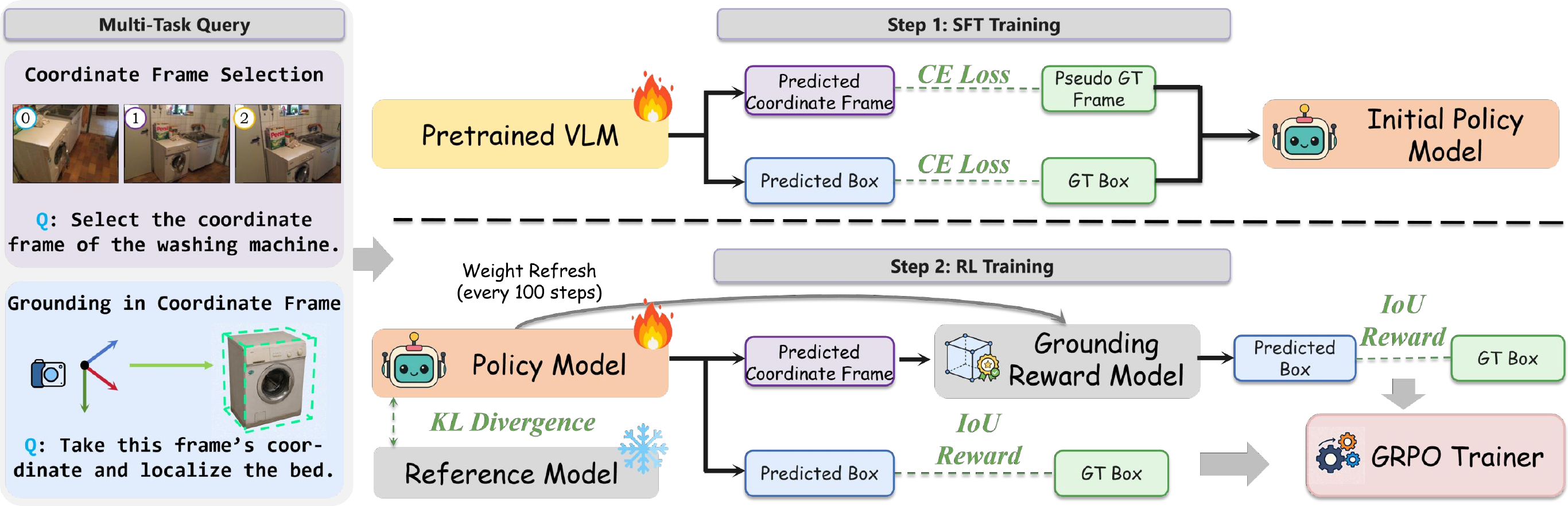
Multiview image-based 3D visual grounding predicts a coordinate frame to define a coordinate system and then regresses a 3D bounding box for localization. However, existing methods jointly optimize coordinate frame selection and box regression, leading to coordinate-relative box ambiguity and degraded grounding performance. This ambiguity arises because the same box admits different numerical representations across coordinate frames, creating multiple optimization targets and yielding invalid compromise predictions. To tackle this challenge, we propose CoordRefer, a coordinate-aware framework that decouples coordinate frame selection from coordinate-conditioned grounding. CoordRefer first selects a reference frame to define the coordinate system and then conditions 3D box prediction on the coordinate system. We perform coordinate-aware supervised fine-tuning to establish coordinate frame selection and coordinate-conditioned box regression, followed by Group Relative Policy Optimization with 3D IoU-based rewards to align both stages with downstream grounding quality. On ScanRefer with Qwen3-VL-2B, CoordRefer achieves gains of +11% Acc.25 and +7% Acc.5 over the coordinate-agnostic baseline, while its geometrically refined variant surpasses methods using explicit 3D inputs.
Coordinate-aware SFT establishes correspondence; IoU-driven GRPO optimizes both stages.
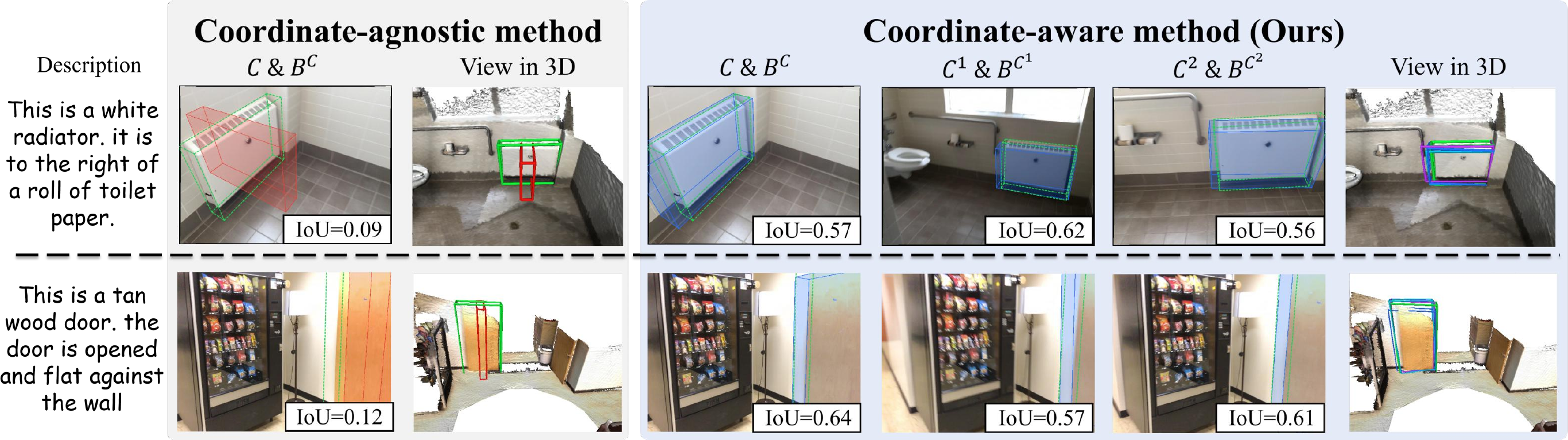
Coordinate conditioning produces more accurate and spatially consistent 3D boxes.
The same formulation generalizes across single- and multi-object queries.
Strong RGB-only grounding, competitive 3D-refined results, and zero-shot generalization.
In-domain comparison across four benchmarks.
| Method | ScanRefer | NR3D | SR3D | Multi3DRefer | ||||
|---|---|---|---|---|---|---|---|---|
| Acc@.25 | Acc@.5 | Acc@.25 | Acc@.5 | Acc@.25 | Acc@.5 | F1@.25 | F1@.5 | |
| SPAR | 31.9 | 12.4 | — | — | — | — | — | — |
| VG-LLM-4B | 36.4 | 11.8 | 25.3 | 7.5 | 28.7 | 9.8 | 31.8 | 11.2 |
| VG-LLM-8B | 41.6 | 14.9 | 31.5 | 11.3 | 37.2 | 14.1 | 38.6 | 14.8 |
| 3D-RFT-4B | 42.9 | 15.9 | — | — | — | — | — | — |
| Qwen3-VL-2B† | 39.7 | 16.4 | 27.4 | 10.6 | 31.5 | 12.8 | 34.4 | 14.8 |
| CoordRefer-2B | 51.1 | 23.6 | 42.1 | 17.2 | 42.6 | 17.8 | 45.4 | 20.8 |
| Improvement | +11.4 | +7.2 | +14.7 | +6.6 | +11.1 | +5.0 | +11.0 | +6.0 |
In-domain comparison on ScanRefer.
| Method | Acc@.25 | Acc@.5 |
|---|---|---|
| ScanRefer | 37.3 | 24.3 |
| 3D-LLM | 30.3 | — |
| Grounded 3D-LLM | 47.9 | 44.1 |
| LLaVA-3D | 54.1 | 42.4 |
| Video-3D LLM | 58.1 | 51.7 |
| CoordRefer-2B* | 60.0 | 53.4 |
Train on ScanRefer, evaluate on ARKitSceneRefer.
| Method | Acc@.25 | Acc@.5 |
|---|---|---|
| VG-LLM-4B | 3.4 | 0.2 |
| VG-LLM-8B | 3.7 | 0.1 |
| Qwen3-VL-2B† | 6.2 | 0.6 |
| CoordRefer-2B | 7.9 | 0.7 |
| Video-3D LLM | 0.2 | 0.0 |
* 3D refinement † Coordinate-agnostic Qwen3-VL-2B baseline.
@misc{li2026coordrefercoordinateaware3dvisual,
  title={CoordRefer: Coordinate-Aware 3D Visual Grounding from Multiview Images},
  author={Haijie Li and Jiaxin Zhang and Dave Zhenyu Chen and Youyu Chen and Yanmin Wu and Jian Zhang},
  year={2026},
  eprint={2608.05569},
  archivePrefix={arXiv},
  primaryClass={cs.CV},
  url={https://arxiv.org/abs/2608.05569}
}